Saturday, 10 February 2018

Math article 2015

When love and maths go together!

Simple mathematical rules, according to the author, can be of great use in life and love.

Updated: April 5, 2015, 4:11 PM IST

Simple mathematical rules, according to the author, can be of great use in life and love.

New Delhi: Mathematics can prove to be a crucial tool for understanding love by negotiating its complicated, often baffling, sometimes infuriating and always interesting mysteries, says maths expert Hannah Fry. In "The Mathematics of Love: Patterns, Proofs, and the Search for the Ultimate Equation", brought out as part of TED Books, the author uses her models to study patterns in human behaviour from riots and terrorism to trade and shopping.

"Love, like most things in life, is full of patterns: from the number of sexual patterns we have in our lifetime to how we choose who to message on an internet dating website. And mathematics is ultimately the study of patterns - from predicting the weather to the fluctuations of the stock market, the movement of planets or the growth of cities. These patterns twist and turn and warp and evolve just as the rituals of love do," the book, published by Simon & Schuster, says.

Simple mathematical rules, according to the author, can be of great use in life and love. "That's why all mathematicians make famously excellent lovers (and dancers). Who knew math could give you such a lovely and moral way to live?" The book seeks to answer several questions like what are the chances of finding love, how important is beauty, how to maximise a night on the town and how to live happily after marriage. It also talks about online dating, the dating game, the maths of sex and settling down.

According to Fry, her aim was not to "replace any of the other excellent sources available on the science of human connection" but "offer a different perspective on the most talked-about subject in the history of human existence, using mathematics as a guide".

She has framed most of the examples in the book using the traditional story of man meets woman. "This is simply because having two clear groups targeting each other can help to make the maths a lot simpler. The choice of examples aside, though, all the results and tips in the book are general enough to apply to any gender and sexuality," writes Fry, a complexity scientist from University College London's Center for Advanced Spatial Analysis.

From evaluating the best strategies for online dating to defining the nebulous concept of beauty, Fry tries to prove that math is a surprisingly useful tool to negotiate the complicated, often baffling, sometimes infuriating, always interesting, mysteries of love.

Fry's first TED talk attracted more than 500,000 views across all TED channels and evolved into her first book "The Mathematics of Love". In the chapter on online dating, the author suggests, "When choosing a profile picture, you should play up to whatever makes you different - including the things that some people might not like. So be proud of that bald patch, show off that ill-advised tattoo, and get that belly out."

So how can one have a successful relationship? "The most successful relationships are the ones with a really low negativity threshold. In those relationships, couples allow each other to complain and work together to constantly repair the tiny issues between them. "In such a case, couples don't bottle up their feelings, and little things don't end up being blown completely out of proportion," Fry says.

News about maths 2014

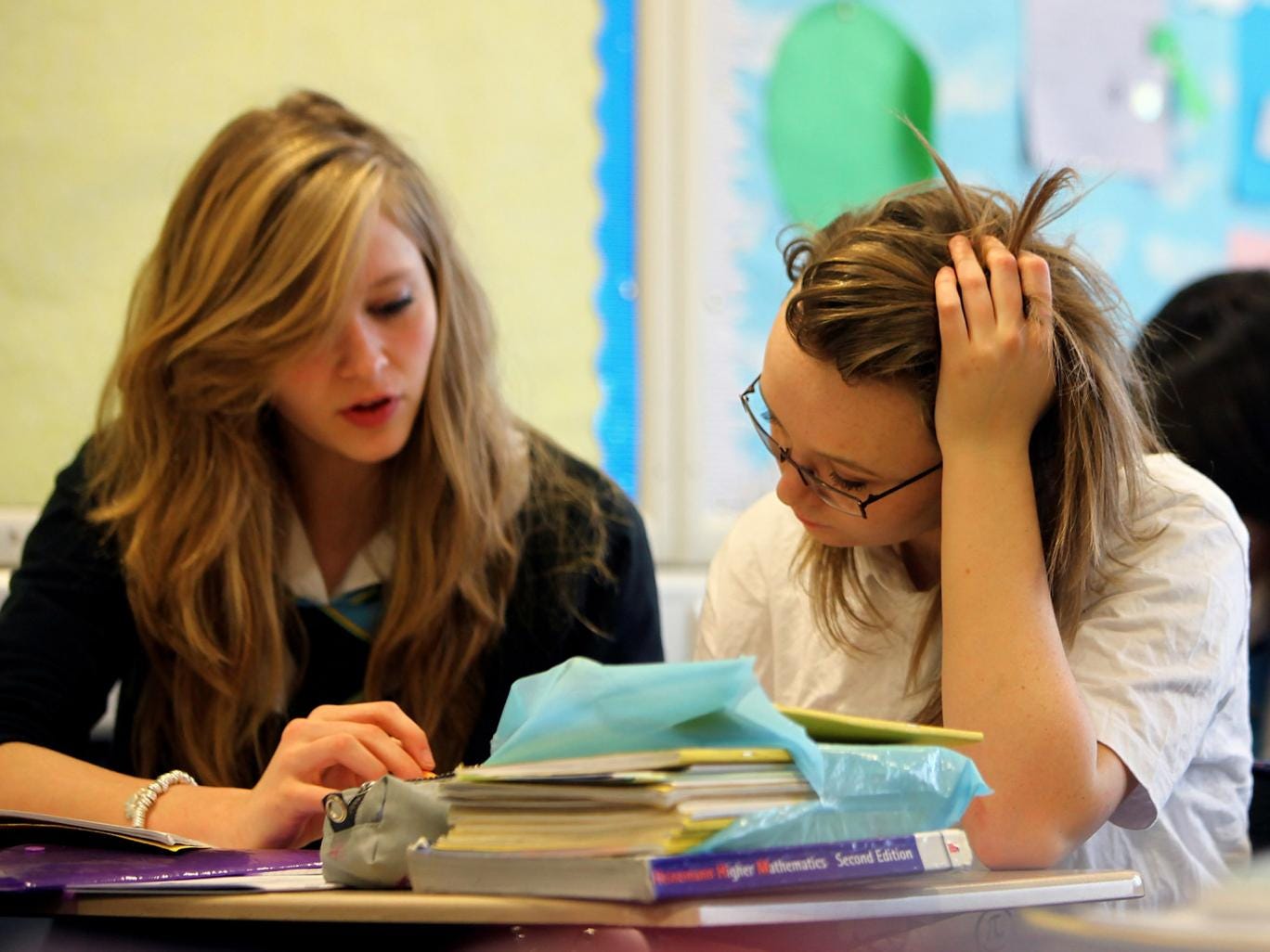
Gender gap in UK schools means girls' lack of confidence in maths and science puts them off applying for engineering jobs


Richard Garner Thursday 23 January 2014Maths is the only subject where girls still lag behind boys Getty Images

Girls lack confidence in their ability in maths and science and are therefore put off from applying for jobs in engineering and computing, a new study from the Organisation for Economic Co-operation and Development (OECD) shows today.

Figures show maths is the only subject where they still lag behind boys and that the lowest performing girls in the UK are six years behind the average pupil in Shanghai, China, by the time they reach the age of 15.

Also, in terms of degree awards, 76 per cent of those in education-related subjects go to girls while only 19 per cent and 23 per cent in computing and engineering are awarded to women.

As a result, the gender gap in terms of career choices was alive and well in the UK, the report stated.

“Many girls choose not to pursue careers in science, technology, engineering and mathematics because they do not have the confidence to excel in mathematics - despite having the capacity to do so,” concludes the report.

Andreas Schleicher, deputy director of education and skills at the OECD, criticised the way maths was taught in the UK - saying lessons in the UK concentrated on solving simple problems without attempting to get pupils to understand the underlying concepts, as happened in high performing Asian countries.

Girls in the UK who were in the lowest quarter of performers fared worse in maths tests than the average for the OECD - scoring 367 points compared with 375 which put them behind Mexico in the tables.

When quizzed, only 40 per cent of UK girls said they would be likely to pursue a career that involved maths - compared with 50 per cent of boys.

“When they think about science, they think more about health related professions - when boys think about science they think about engineering and computer related professions,” Mr Schleicher added.

He said he had visited a careers convention earlier in the day which had included a presentation by a female electrician, adding that he had heard one girl say: “I didn’t think you could become an electrician if you are a woman.”

Mathematical universe

Our Mathematical Universe: My Quest for the Ultimate Nature of Reality by Max Tegmark, book review

Theories that aim to unlock the mysteries of maths, physics and perhaps the universe

Peter Forbes Friday 24 January 2014Illuminating: the 'Whirlpool Galaxy' AP

There may or may not be a multiverse but there is certainly a multitude of books about the topic. In Our Mathematical Universe, Max Tegmark – a distinguished cosmologist – gives a lucid rundown of the current state of knowledge on the origin, present state, and fate of the universe(s).

But he also goes beyond this, outlining a Grand Theory of Everything, the seeding idea of which is a famous remark in 1960 by the physicist Eugene Wigner: "The enormous usefulness of mathematics in the natural sciences is something bordering on the mysterious." His research has led him to a Douglas Adams moment (Adams is often cited). Tegmark puts it like this: "I know of no other compelling explanation for this trend [the ability of maths to explain the physical world] than that the world really is completely mathematical."

The instant reaction of most lay readers to this will be: "Then where does all the stuff come from: the heavy, dangerous explosive stuff?"? Tegmark's answer is Alan Guth's cosmological theory of Inflation, an extrapolation of Einsteinian ideas of space-time and gravity, coupled with our knowledge of the cosmic background radiation – on which Tegmark has done groundbreaking work. All this adds up to the apparent creation of something from nothing by borrowing energy from the quantum vacuum. This free-lunch theory of creation is, he admits, superficially like the kind of Ponzi-scheme financial trickery of Bernie Madoff – a pyramid-selling operation heading for one almighty collapse, which, of course, is what might well happen to the universe one day.

This is a book that provokes many different reactions as it proceeds. It is immensely illuminating on the reach of current cosmological theories but one persistent strand is bound to baffle many readers. Although Tegmark rejects many current speculations that bemuse lay people (eg quantum consciousness; humans as simulations in some alien's computer game), he constantly returns to a notion equally outlandish: a version of quantum mechanics that implies countless clones of ourselves inhabiting parallel universes.

And there is not even merely one kind of multiverse but four, described in detail! From time to time, Tegmark engagingly admits that such ideas sound like nonsense, but he makes the crucial point that if a theory makes good predictions you have to follow all of the consequences. You can't say, for instance: yes, the climate is warming (sparkling wine from the South Downs!) but I'll skip the extreme weather, thank you very much (my example, not Tegmark's).

Having stretched our minds to encompass forbidding concepts of mathematically plausible universes, in the last chapter he comes to the old-fashioned humanist conclusion that there is no point looking for uplift and moral guidance in all this: "our Universe does not give life meaning but life gives our Universe meaning". Or, as Philip Larkin wrote, "none of this cares for us". His concluding chapter on the risks humanity faces is wise and bracing: he believes we "are alone in our Universe" but are capable of tackling terrible threats from cosmic accidents, or self-induced nuclear or climatic catastrophes. He doesn't cite poets but his philosophy adds up to an updated 21st-century version of Thomas Hardy's "If way to the better there be, it exacts a full look at the worst".

Largest known prime number

Largest known prime number discovered in Missouri

The prime was discovered by a US mathematician using a computer programme

Caroline Mortimer Wednesday 20 January 2016. REX Features

The largest known prime number has been found by a computer programme at a US university.

Prime numbers can only be divided by themselves and one, and are vital for computer encryption.

The new number - written as 2^74,207,281-1 - is more than 22 million digits long and was published by Dr Curtis Cooper at the University of Central Missouri.

Maths teaching in UK is superficial

Maths teaching in the UK is 'superficial', says education expert

Andreas Schleicher of the OECD says British schoolchildren are falling behind with lessons 'a mile wide and an inch deep'

Alison Kershaw Sunday 13 March 2016Andreas Schleicher of the Organisation of Economic Co-operation and Development says that British schoolchildren are falling behind in maths because lessons in the subject are 'a mile wide and an inch deep' Rex
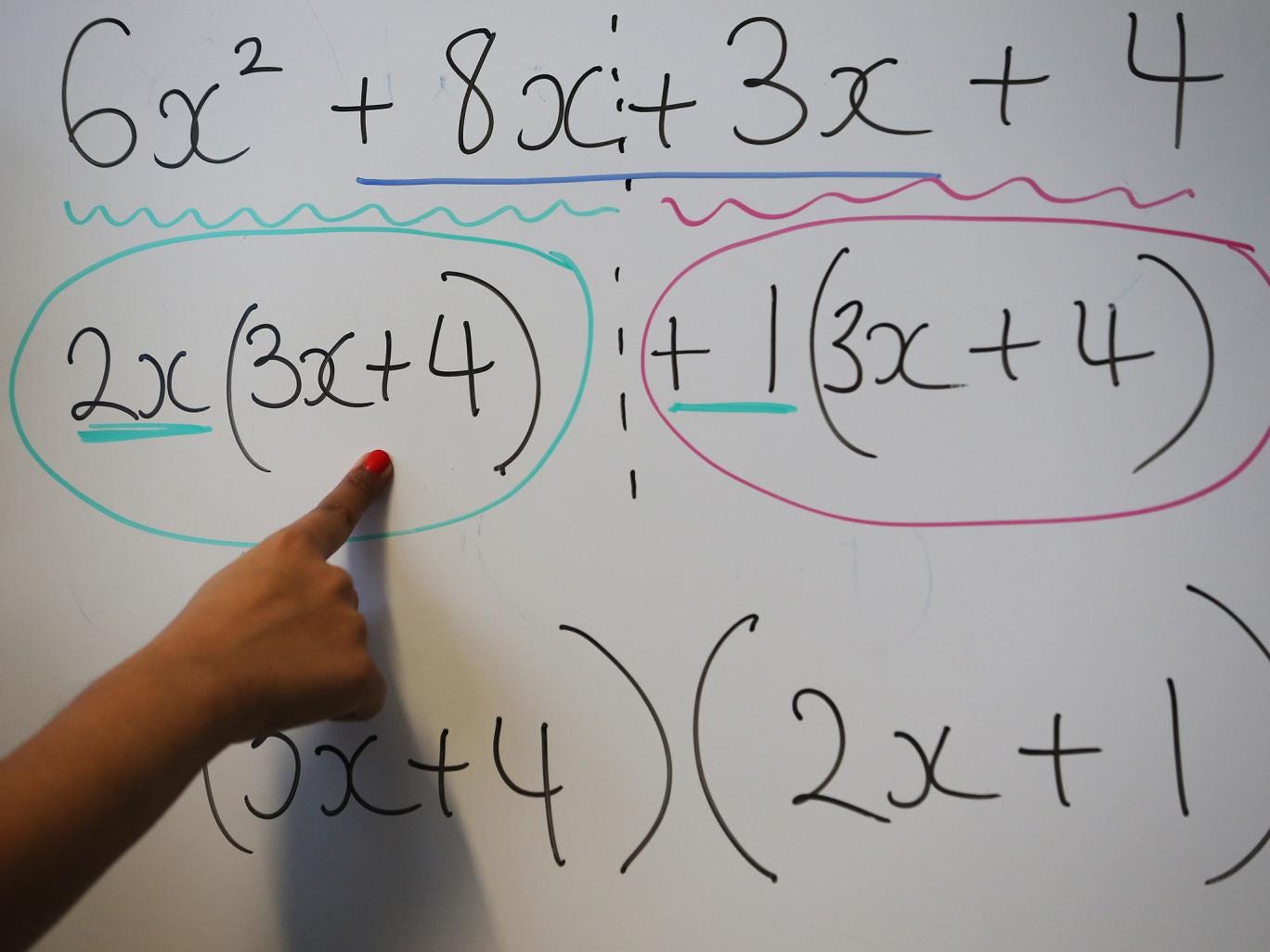
British schoolchildren are falling behind in maths because lessons in the subject are “a mile wide and an inch deep”, according to an international education expert.

Maths teaching in the UK is “superficial” because it is focusing on memorising and learning facts, rather than concepts, said Andreas Schleicher, of the Organisation of Economic Co-operation and Development.

“One of the things that we see when you look at high-performing education systems in maths, they typically have three things in the curriculum; one is rigour, the second is focus and the third is coherence,” he said, ahead of the Global Education and Skills Forum in Dubai.

READ MORE

UK FOLLOWS RUSSIA'S EXAMPLE TO SET UP SPECIALIST MATHS COLLEGES

“Rigour means really having a high level of cognitive demand, and the UK is not doing well on it. Basically, the UK has a curriculum that is a mile wide and an inch deep, in the sense that a lot of the learning in maths is rather superficial.”

He suggested that maths teaching in the UK tends to be over-complicated, rather than taught in a simple fashion to ensure pupils grasp a concept. In comparison, East Asian education systems – which traditionally top international league tables – teach fewer topics in more depth and emphasise understanding.

Mr Schleicher said the UK is not doing badly in international tests, but is still far away from the highest performing systems. The latest Pisa tests, from 2013, put England in 26th place for maths, behind Singapore, Taiwan, South Korea and Japan.

Budget 2016-compulsory maths lesson upto age of 18

Budget 2016: Maths lessons could become compulsory for all pupils up to age of 18

Move is part of a blueprint to ensure next generation of schoolchildren get the 'best start' in life for employment

Richard Garner Education Editor Wednesday 16 March 2016Education reform remains a key government focusGetty Images
Maths lessons could become compulsory for all pupils up until the age of 18.

Chancellor George Osborne announced the setting up of a review to determine whether the subject should be studied by all children until they leave education as part of a blueprint to ensure the next generation gets the “best start” in life for employment. In England, young people already have to stay in school or training until they are 18.

It was one of a series of measures unveiled by the Chancellor to ensure that reforming the education system remains a key government focus.

READ MORE

OVER ONE IN FIVE SECONDARY SCHOOL MATHS TEACHERS LACKING DEGREE

Mr Osborne also announced he would bring forward the introduction of a “fair funding formula” to ensure all schools received an equitable level of Government cash. The new system would be introduced by 2020.

At present, inner city schools receive more funding than those in rural areas - leading to claims that any attempt to tamper with funding would deprive disadvantaged pupils in urban areas. However, the Chancellor announced that an extra £500 million would be earmarked to cushion the blow for areas that have been well-funded in the past.

Square root day

Square Root Day: There are only nine days this century like this

The day was coined and publicised by a former high school teacher from California

Andrew Buncombe New York Monday 4 April 2016There are only nine such days every century Ron Gordon

There is no national holiday. People do not get a day off work.

But for a certain type of person, there are fewer more exciting days than the fourth of April 2016.

The date so written - 4/4/16 - represents just one of nine so-called Square Root Days every century. The last was celebrated on March 3 2009 and the next one will be marked on May 5 2025.

President Barack Obama may be America's first and only square root president (Getty Images)

But according to the man who coined the day, Californian mathematician Ron Gordon, today’s Square Root Day is more special than most; it also marks the start of the Major League Baseball Season and is taking place during the administration of Barack Obama, who this year became the first - and perhaps only - “square root president”.

“There are a lot of bonuses to today,” Mr Gordon told The Independent. “We have Obama, the 44th president, governing in 2016. He is the first and probably the only square root president.”

Mr Gordon said presidents Polk (#11) Cleveland (#22) and Truman (#33) did not make it.

“We’ve had 44 presidents in 229 years, averaging 5.2 years in office for each. Presidents 55 and 77 won’t come close to that pattern,” he said.

“The three remaining possibilities? Averaging just under 5.41 years going forward, we could have President #66 in 2136. With a bit over 5.61 years, we could see President #88 in 2264, and if they average 4.8 years in office, our 99th President would serve in 2281.”